
To describe your perfume preferences, explain what you enjoy, what you would like less of, where you plan to wear the fragrance, and what you want to explore next. You can do all of that in ordinary language. You do not need to recognise individual ingredients or memorise a fragrance wheel.
Perhaps you know a perfume is almost right, but “too much” is the only description that comes to mind. Or you ask for something fresh, then realise the suggestions do not resemble what you meant. A little more detail can turn that vague reaction into a useful shopping brief.
Start with a fragrance you already know
Choose one perfume you have actually worn. It does not have to be a favourite; a near miss can be just as useful.
Write its exact name and version if you know them, then finish this sentence: “The part I enjoy is…” Focus on your own impression. You might write “the crisp beginning,” “the soft scent left later,” or “the way it reminds me of clean laundry.”
Those descriptions do not claim to identify a formula. They explain what caught your attention. If you have never worn perfume, begin with a familiar smell you enjoy and make that clear: you are describing a preference, not reporting a fragrance test.
Replace broad labels with one concrete detail
Words such as fresh, warm, clean and sweet are useful starting points, but they leave room for interpretation. Add a comparison or a contrast in your own words.
For example, “fresh like citrus peel” gives a different brief from “fresh like a clean shirt.” Neither is more sophisticated. Each helps explain the experience you have in mind.
Try these prompts:
- Sweet: Is that the part you enjoy, or does it become more than you want?
- Soft: Do you mean a gentle impression, or a scent you prefer to notice only occasionally?
- Dark: What does it remind you of—wood, smoke, leather, or something else?
If none of those words fits, leave it out. “I keep wanting to smell it again, but I cannot name the reason” is more honest than borrowing a note description you do not recognise.
Explain the near miss
“I dislike this perfume” can end a conversation. “I enjoy the opening, but later it feels sweeter than I want” gives the next choice a direction.
Separate the part you like from the part you would change. You may enjoy a scent in principle but dislike the amount you applied, the setting you wore it in, or how it felt later. Record those details without assuming you have found a universal rule about an ingredient.
For instance, disliking one perfume with vanilla in its description does not tell a recommender exactly what you disliked. Tell them what happened during your wear. “I wanted less sweetness by lunchtime” is a clearer brief than “no vanilla, ever” unless that firm preference is genuinely yours.
Add the setting, not an imaginary lifestyle
Describe where you expect to wear your next fragrance. A quiet evening at home, a shared workspace and an outdoor weekend are different personal briefs. Include any fragrance restrictions that matter in that setting.
Then say how you want the experience to feel. Perhaps you want a familiar scent you can choose without thinking, or something unusual to explore on your own time. That tells someone more than asking for a perfume that works “everywhere.”
Keep practical preferences separate from scent preferences. Wanting a small decant for occasional use is a buying decision; enjoying a woody impression is a description of taste. Both belong in the conversation, but they answer different questions.
Put it into a four-part fragrance brief
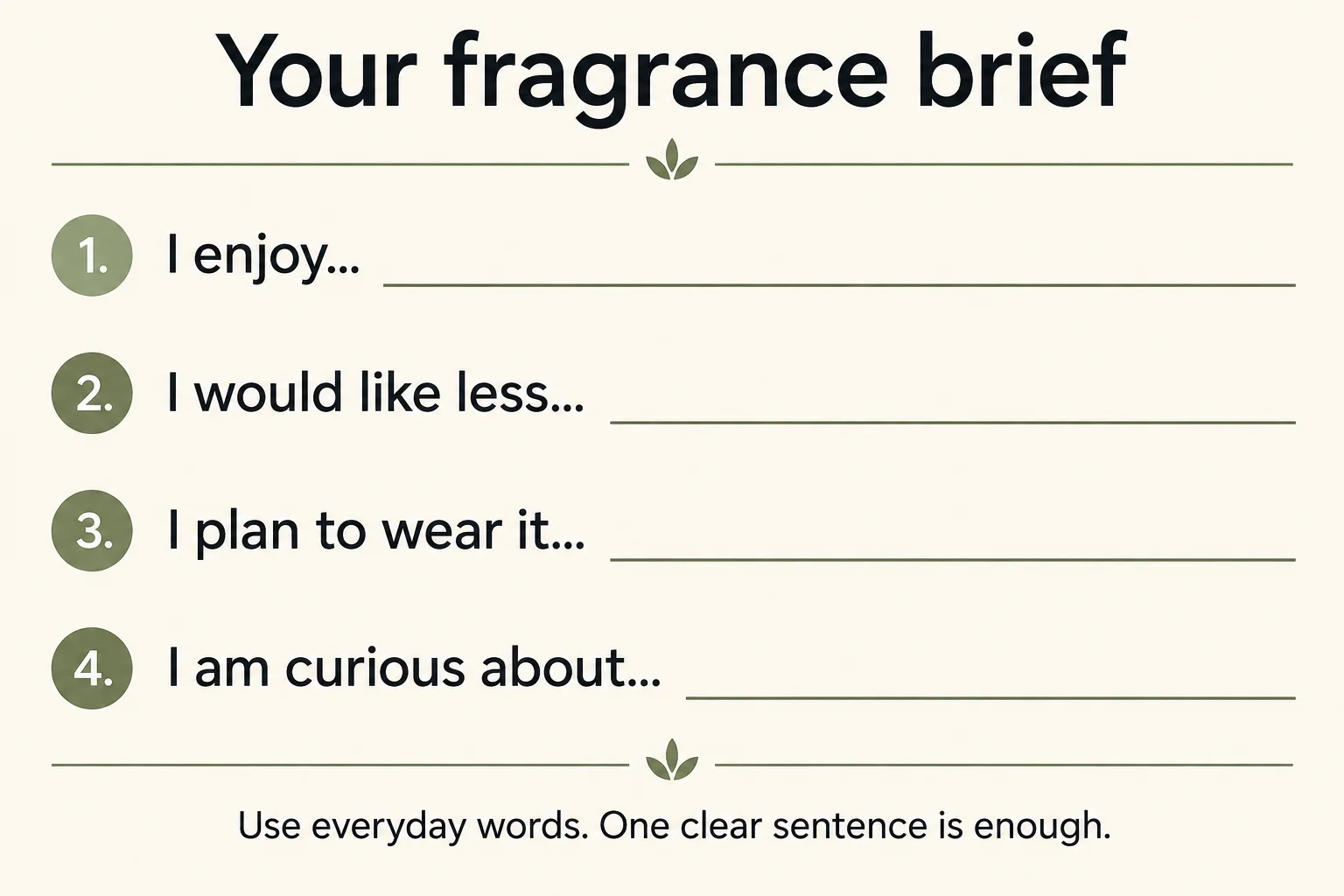
Use these four prompts when making a shortlist or asking for help. AI-generated worksheet; the same prompts are provided below as text.
Copy this into your notes:
- I enjoy… Name a fragrance or describe an impression you like.
- I would like less… Explain the part of a previous experience you would change.
- I plan to wear it… Give a real setting or occasion.
- I am curious about… Name one direction you would like to explore.
Here is a hypothetical example: “I enjoy a bright, crisp beginning, but I would like less sweetness later. I want something for relaxed weekends, and I am curious about a more woody direction.”
That brief is specific enough to guide a shortlist without pretending you already know the answer. It also gives you a clear question to bring to the next wear.
Let the next decant refine your vocabulary
Use your brief while browsing the Fragnatium fragrance collection, or include it when asking for help through Support. Treat recommendations as candidates to explore rather than promises of a perfect match.
After trying a candidate, change one line in your brief. You might discover that you want more contrast, less sweetness, or simply more of the fragrance you already enjoy. Our perfume-decant testing guide offers a routine for recording that experience.
You are not trying to sound like a perfumer. You are building a description that helps you choose. A few accurate words about your own experience are enough to make the next conversation more useful.
Featured image: AI-generated editorial illustration, not a photograph of Fragnatium packaging or a record of a wear test.